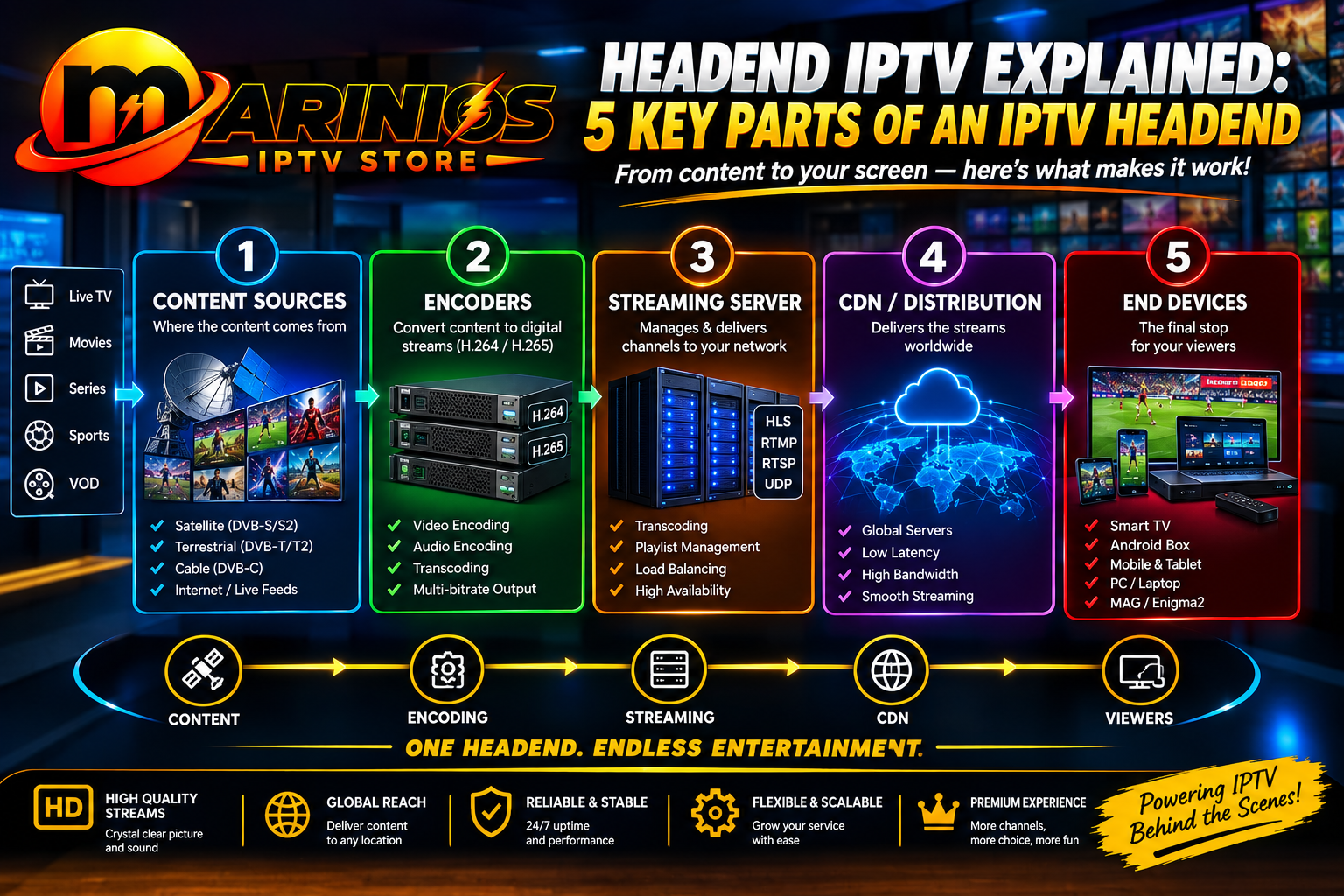
A headend IPTV system is the engine room of every IPTV service. It is where TV signals are received, encoded, organised and pushed out to thousands of viewers at once. You never see it, but it decides almost everything you notice on screen: picture quality, how fast channels switch, and whether the stream freezes on match night. This guide explains what an IPTV headend is, its five main parts, how it differs from a cable headend, and why it matters when you choose a service like Marinios IPTV.
What Is a Headend IPTV System?
In broadcasting, a “headend” is the central facility that receives TV signals and processes them for distribution (Wikipedia: cable television headend). A headend IPTV system does the same job, but instead of sending signals down coaxial cable, it converts them into IP (internet protocol) streams that travel over networks to apps and set-top boxes.
Headend IPTV systems are used by telecom operators, hotels, hospitals, universities, stadiums and IPTV service providers. The scale varies from a few channels in a hotel to tens of thousands of channels for a global IPTV platform.
The 5 Parts of an IPTV Headend
1. Signal acquisition (sources)
Satellite receivers, terrestrial tuners, fibre feeds, SDI/HDMI inputs and IP sources capture the original channels. For on-demand content, the source is a media library of movie and series files.
2. Encoders and transcoders
Encoders compress raw video into efficient formats such as H.264 (AVC) or H.265 (HEVC). Transcoders create several versions of each channel — for example 4K, 1080p and 720p — so players can switch quality based on bandwidth. This is called adaptive bitrate streaming. Our IPTV 4K guide explains why bitrate matters for real 4K.
3. Packagers and stream processors
The encoded video is packaged into delivery formats such as HLS or MPEG-TS, split into small segments, and tagged with metadata — audio tracks, subtitles and EPG information.
4. Middleware and management
Middleware handles user accounts, subscriptions, channel lists, the electronic programme guide (EPG), and the number of simultaneous connections each customer can use. It is what the IPTV player app talks to when you log in.
5. Streaming servers and CDN
Origin and edge servers deliver the streams to viewers. A content delivery network (CDN) spreads load across many locations so that a spike — like a big kickoff — does not overwhelm one server.
| Headend IPTV component | Job | What viewers notice |
|---|---|---|
| Sources | Capture channels and content | Channel coverage |
| Encoders / transcoders | Compress and create quality levels | Sharpness, real 4K vs fake |
| Packagers | Segment and add audio/subtitles | Multi-audio, subtitles, delay |
| Middleware | Accounts, EPG, channel lists | Login, guide accuracy |
| Servers / CDN | Deliver streams at scale | Buffering or no buffering |
How a Channel Travels Through a Headend IPTV System
- A satellite or fibre feed delivers the live channel to the headend.
- The encoder compresses it to H.264/H.265 and the transcoder creates 4K, FHD and HD versions.
- The packager splits each version into 2–6 second segments and adds subtitle and audio tracks.
- Middleware adds the channel to customers’ lists and links it to the EPG.
- Servers and the CDN deliver the segments to every viewer who opens the channel.
- The viewer’s IPTV player buffers a few segments and plays them.
For the viewer’s side of this chain, read IPTV streaming explained.
IPTV Headend vs Cable Headend
| Aspect | Cable headend | Headend IPTV |
|---|---|---|
| Delivery | RF over coaxial/HFC network | IP packets over internet or managed networks |
| Reach | Only homes on the operator’s cable | Any device with internet |
| Interactivity | Limited | VOD, EPG, catch-up, multi-device |
| Scaling | Physical network build-out | Add servers and CDN capacity |
| Customer hardware | Rented set-top box | Devices you already own |
Why the Headend Decides Your Stream Quality
Two IPTV services can carry the same channel and look completely different. The reasons are almost always in the headend IPTV setup:
- Encoder quality and bitrate decide whether 4K is truly sharp.
- Transcoding ladders decide whether the stream adapts smoothly or freezes when your bandwidth dips.
- Server and CDN capacity decide whether the stream holds up when tens of thousands of people watch the same match.
- Middleware quality decides how fast you log in and switch channels, and whether the EPG is accurate.
Many resellers do not control any of this — they rent access to someone else’s headend. That is why our guide to IPTV providers recommends asking who owns the servers.
What This Means for Viewers: The Marinios IPTV Approach
If you are a viewer rather than an operator, you do not need to build a headend — you need a provider that has invested in a good one. Marinios IPTV runs its own infrastructure, which lets us control the parts of the headend IPTV chain that matter most to you:
- Adaptive 4K · UHD · FHD encoding for sharp pictures that adjust to your connection.
- Anti-Freeze™ 9.8 delivery servers built for peak traffic, with 99.9% Anti-Freeze uptime.
- 25,000+ live channels and 100,000+ VOD titles, with multi-audio and subtitles.
- A 7-day EPG managed by our middleware.
- Standard player support — IPTV Smarters Pro, IBO Player and more (see our best IPTV player guide).
The result is the Marinios IPTV experience: one login, every channel, and a stream that keeps playing. Plans start at $5.67/month on the 12-month plan — see the pricing page.
See what a strong IPTV headend feels like
Free Marinios IPTV trial — test 4K and live sports on your own TV
Get a Free Trial See PlansMulticast vs Unicast in a Headend IPTV System
A headend IPTV system can send streams in two main ways:
| Method | How it works | Where it is used |
|---|---|---|
| Multicast | One stream is sent once and copied by the network to every viewer who joins | Hotels, campuses, telecom operators’ managed networks |
| Unicast (OTT) | Each viewer receives a separate stream from the server or CDN | Internet IPTV services such as Marinios IPTV |
Multicast is very efficient, but it only works on networks the operator controls. Internet-delivered IPTV uses unicast, which is why server and CDN capacity matter so much: every additional viewer is another stream to deliver. A big match can multiply demand in seconds — the scenario Marinios IPTV’s Anti-Freeze™ 9.8 servers are designed for.
Headend IPTV for Hotels and Businesses vs Consumer IPTV
When businesses search for “headend IPTV”, they usually want an in-house system: a rack of satellite receivers, encoders and a small server that distributes 20–200 channels to rooms or screens over the building’s network. Consumer IPTV services work at a very different scale.
| Aspect | In-house headend (hotel, hospital) | Consumer IPTV service |
|---|---|---|
| Channels | Tens to a few hundred | Thousands — 25,000+ with Marinios IPTV |
| Viewers | Inside one building | Anywhere with internet |
| Delivery | Usually multicast on a LAN | Unicast over the internet |
| Cost | Hardware purchase plus maintenance | Monthly or yearly subscription |
| On-demand library | Rare | Standard — 100,000+ titles with Marinios |
If you are a viewer or a household, you do not need to buy headend equipment at all. A subscription gives you access to a provider’s full headend IPTV infrastructure for a few dollars a month.
Key Specs to Know in an IPTV Headend
- Codecs: H.264 for compatibility, H.265/HEVC for efficient 4K.
- Containers and protocols: MPEG-TS, HLS and sometimes DASH.
- Transcoding profiles: the ladder of resolutions and bitrates offered per channel (for example 2160p, 1080p, 720p).
- Segment length: shorter segments reduce delay; longer segments are more stable.
- Redundancy: backup sources and failover servers so channels stay up.
- EPG ingest: how guide data is collected and matched to channels.
- Concurrent connection control: how middleware enforces the device limit on each account.
Where Headend IPTV Is Heading
Headend IPTV systems are moving to software and the cloud. Instead of racks of dedicated encoders, more providers run software encoders on general servers, scale up automatically for big events, and use more efficient codecs to deliver 4K at lower bitrates. For viewers, that means sharper pictures and fewer freezes on the same internet connection. Marinios IPTV keeps investing in this side of the platform so customers benefit without changing a thing at home. To see how this reaches your screen, read what is an IPTV service.
Headend IPTV FAQ
What is a headend in IPTV?
It is the central system that receives TV signals, encodes them into internet video, manages users and channel lists, and delivers streams to viewers.
What does an IPTV encoder do?
It compresses raw video into formats like H.264 or H.265 so it can travel efficiently over the internet, often in several quality levels.
Who uses headend IPTV systems?
Telecom operators, IPTV service providers, hotels, hospitals, campuses, stadiums and large businesses.
Do I need a headend to watch IPTV?
No. Viewers only need an internet connection, a device, a player app and a subscription such as Marinios IPTV. The provider runs the headend.
Does the headend affect buffering?
Yes. Encoding, transcoding and server capacity in the headend are among the biggest factors behind buffering.
Conclusion
A headend IPTV system turns raw TV signals into the smooth streams you watch on your phone or TV. Its encoders decide sharpness, its middleware decides convenience, and its servers decide whether the picture freezes at the worst moment. When you choose an IPTV service, you are really choosing its headend. Marinios IPTV invests in every layer of it — try it free and judge the result yourself.
Marinios IPTV — built on our own servers
25,000+ channels · 4K · Anti-Freeze™ · from $5.67/month
Get Marinios IPTV